Modern insurance rating engines are reshaping the way insurers think about deployment.
For years, pricing engines were an IT headache: complex integrations, unpredictable costs, and maintenance bottlenecks that slowed business teams down. But cloud-native technology has flipped the script, transforming the insurance pricing engine from a technical constraint into a strategic enabler.
This article explores how IT leaders can modernize their rating engine deployment, turning long-standing pain points into opportunities for agility, scalability, and business impact.
The Legacy Challenge – When Innovation Meets Bottlenecks
If you’ve ever led a pricing project in insurance, you know the pattern.
A new model is ready. The business is eager to roll it out. Then reality hits: months of integration, middleware setup, capacity planning, and endless testing.
Meanwhile, business stakeholders ask: “Why is this taking so long?”
Legacy architectures weren’t built for agility. They make every change a mini project, every update a risk. The result: innovation that moves at the speed of infrastructure, not strategy.
It’s time to change that.
The Turning Point – Rating Engine Integration Without Friction
The transformation begins with API-first.
By leveraging RESTful APIs, standard JSON, and OpenAPI 3.x compatibility, integration becomes fast, familiar, and friction-free.
No proprietary protocols: Your developers use the same modern tools they use everywhere else.
Stateless by design: Scale easily without needing to remember that it is Bob’s third mid-term adjustment this year. That's the job of your core system.
Self-documenting APIs: Reduce integration errors and accelerate development.
Empowered business teams: Let them test and validate pricing changes independently.
Integration that once took months can now be completed in a matter of days: streamlined, standardized, and far less resource-intensive.
And with versioned APIs, updates no longer break old integrations.
This is where IT starts to regain control – not by working harder, but by working smarter.
Scaling Insurance Pricing Deployments Without Cost Anxiety
Once integration is frictionless, scaling becomes the next frontier. Traditionally, IT had to plan for the worst. Renewal season, rate changes, marketing spikes – you over-provision infrastructure “just in case.” But most of that capacity sits idle.
A cloud-native rating engine eliminates that trade-off:
Elastic scalability: automatically adjusts to workload demands, 10x or even 1000x.
Instant elasticity: scale up when volumes spike, scale down when they don’t.
Fixed-cost model: predictable pricing, no surprise cloud bills.
For CIOs, this means technical flexibility and financial predictability – the rare combination that turns IT into a true strategic partner.
Enterprise Security for Insurers, Simplified
In insurance, security isn’t optional, it’s foundational. But maintaining compliance shouldn’t come with enterprise-sized overhead.
A modern pricing engine embeds enterprise-grade security at its core:
SOC2 Type II and ISO 27001 certified
AES-256 encryption and TLS
Role-based access control and MFA
Secure connection configurable through a web interface
No servers to patch, no data centers to certify. You stay compliant, secure, and audit-ready without the overhead.
Operations That Run Themselves
What if your insurance pricing engine could update itself?
With continuous delivery and zero-downtime updates, maintenance becomes invisible:
Automatic updates: no manual patches or maintenance windows.
Built-in versioning: track every model, every deployment.
Guaranteed uptime: 99.95% availability, handled by the platform.
Operations become so seamless they barely need an operations team, freeing IT to focus on strategy, not firefighting.
End-to-End Insurance Pricing – From Modeling to Deployment, Without Disruption
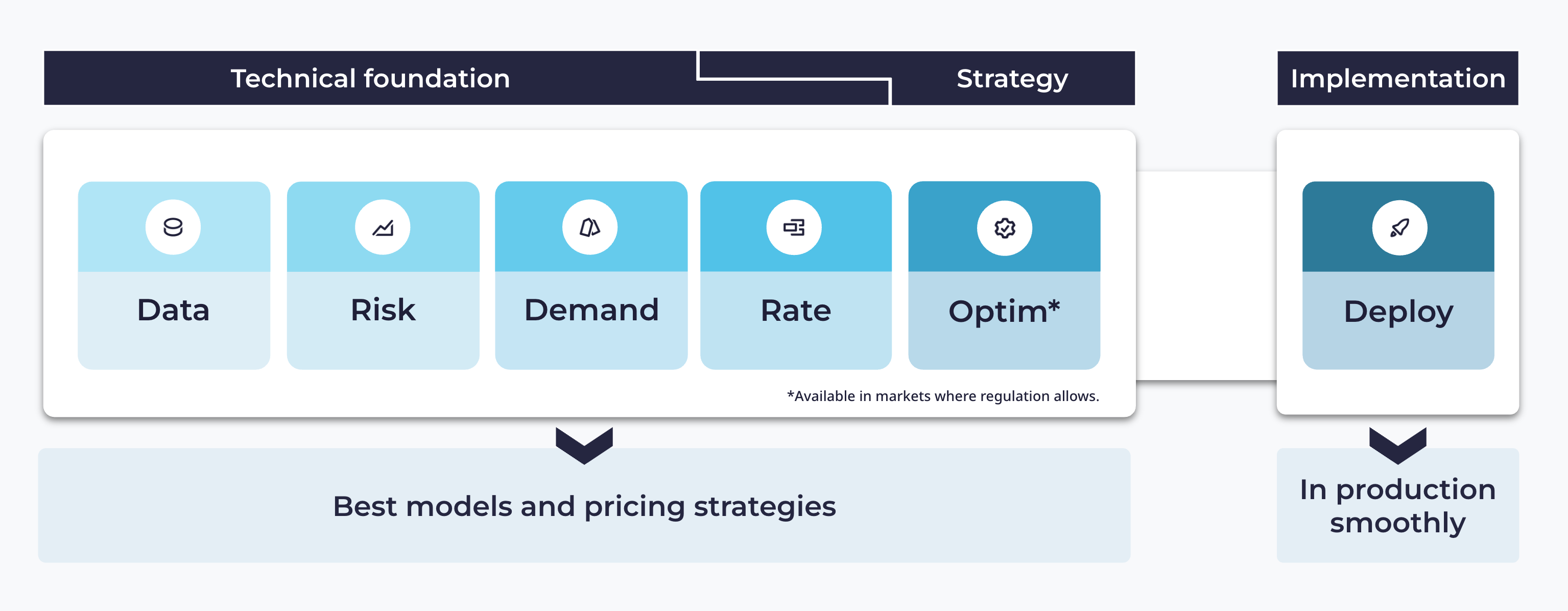
Another breakthrough comes when deployment becomes part of a larger vision: a unified, end-to-end pricing ecosystem.
Pricing agility becomes a true competitive advantage
Actuarial innovation can flow straight into production instantly, securely, and without risk
This is where IT stops saying “we’ll make it work” and starts saying “it’s already working”.
Epilogue: The Invisible Engine That Powers Visible Value
The best insurance pricing engine disappears into the background, quietly empowering business outcomes.
When your rating engine:
requires no maintenance,
scales automatically,
integrates seamlessly, and
connects the full pricing lifecycle from modeling to deployment,
then IT stops being a bottleneck and becomes a strategic enabler.
For insurers, this isn’t just modernization, it’s transformation. The pricing engine becomes the invisible infrastructure behind every visible success.
Ready to see how leading insurers are transforming their pricing operations?
Franck Zerbib is CTO of Akur8. Franck started his career at IBM where he spent 18 years in various technical and technical sales management positions, as Specialist, then Architect, and finally Director of large business units. He then joined Google Cloud to shape and actively contribute to the great acceleration of Google Cloud on its market, and especially in France across all industries. Franck had different positions where he brought his expertise and experience at Google. He went from building dedicated teams to supporting digital native and corporate customers, to leading the whole customer engineering organization in France. Franck decided to leverage his technical leadership experience by transitioning to a more entrepreneurial journey at Akur8.