Building a strong pricing model is key for actuarial teams, but it is only one part of the journey. For the model to create business value, it needs to move through data pipelines, product requirements, IT systems, governance processes, and deployment workflows before it can reach production. That journey rarely belongs to actuaries alone.
Modern insurance pricing is increasingly cross-functional. Actuaries work alongside data scientists, underwriters, IT teams, product teams, business stakeholders, and sometimes external vendors. Each group brings a different perspective, a different vocabulary, and a different definition of success. The challenge is not to eliminate those differences, but to align them around a shared goal.
So how can actuaries collaborate more effectively with IT, data, and product teams? Together with Thomas Holmes, Chief Actuarial Officer at Akur8 and Marianne Farmiga, Senior Solution Architect at Akur8, we sat down to discuss this question.
Start by understanding the insurance value chain
Insurance organizations are complex by nature. Pricing sits at the intersection of multiple functions, each with its own responsibilities and constraints.
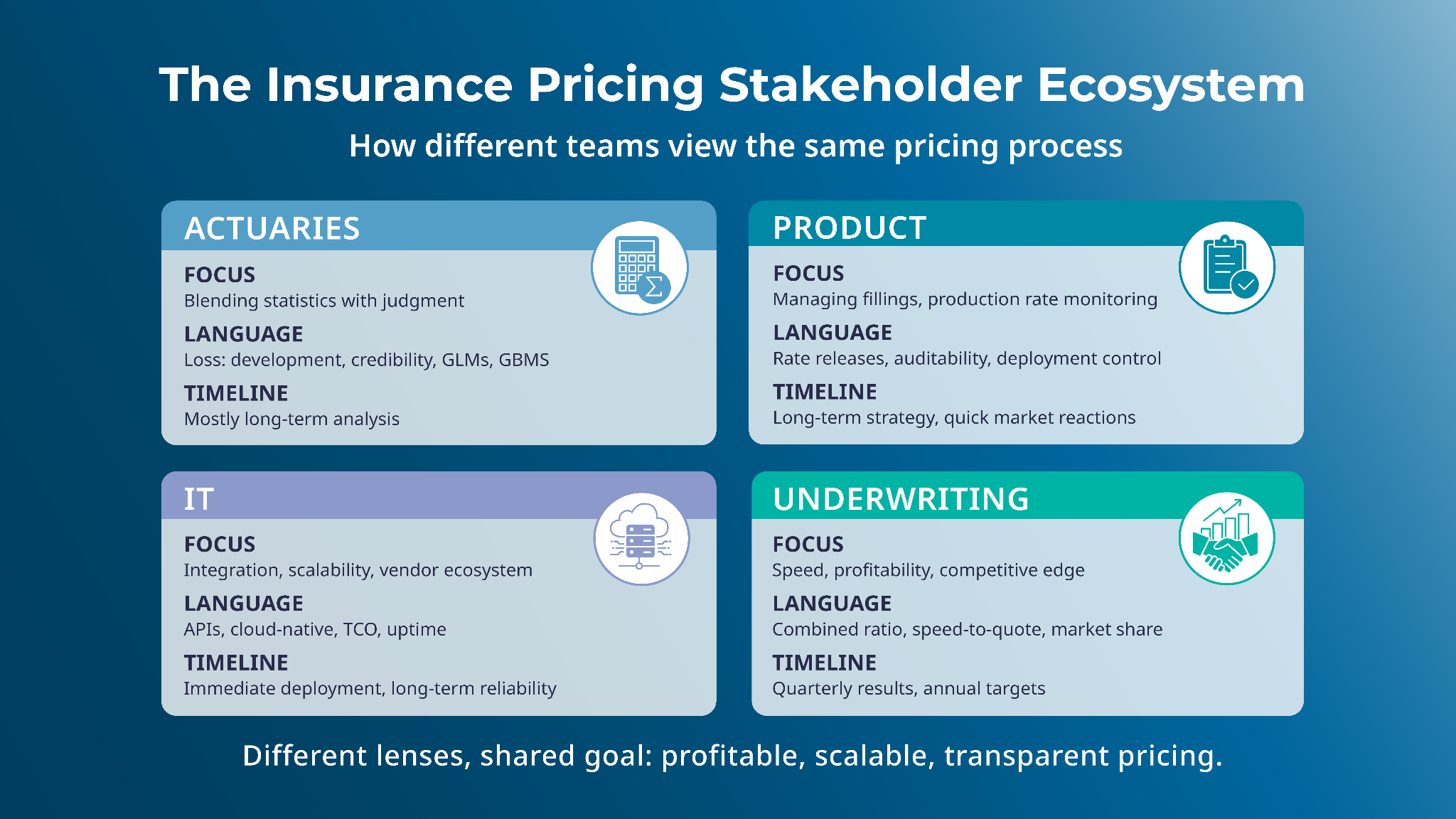
Actuaries may focus on risk adequacy, model performance, credibility, and business impact. Data scientists may focus on predictive performance, features, and methodology. IT teams care about integration, reliability, security, scalability, and maintainability. Product teams often manage timelines, user experience, adoption, and business priorities. Underwriters and business teams may prioritize profitability, market positioning, and operational usability.
None of these perspectives is wrong. In fact, each is necessary.
The problem arises when teams optimize only for their own lens without understanding what the others are trying to achieve. A technically strong model that cannot be deployed efficiently will not create value. A fast deployment process that does not preserve actuarial intent can introduce risk. A product workflow that is intuitive but disconnected from technical constraints may fail in execution.
Effective collaboration starts with a simple discipline: understand the company objective first, then understand how each team contributes to it.
The Insurance Pricing Stakeholder Ecosystem
Focus on the objective before the solution
One of the most common mistakes in cross-functional projects is starting with a predefined solution.
Actuaries are trained to be precise, which is a strength. But in cross-team collaboration, too much specificity too early can limit the room for better solutions. What seems simple from an actuarial perspective may be difficult from an IT standpoint. What feels technically complex to one team may already be easy to support in another team’s workflow. Instead of saying, “I need this exact implementation,” it is often more productive to say, “This is the outcome I need to achieve.”
That shift matters. It allows every function to contribute from its area of expertise. IT can identify the safest or most scalable implementation path. Product can consider workflow and user adoption. Data teams can assess feasibility and data quality. Actuaries can preserve the pricing intent and ensure the final outcome remains technically sound.
The more clearly actuaries can explain the “why” behind a request, the more likely the final solution will serve the broader business objective.
Translate between actuarial and IT language
Misaligned terminology is one of the most underestimated sources of friction in insurance projects.
The same word can mean different things to different teams. An actuary may speak about rating factors, relativities, model constraints, or loss development. An IT team may think in terms of configuration parameters, APIs, data schemas, releases, and uptime. A product team may focus on user journeys, requirements, and adoption.
If these definitions are not aligned early, teams may believe they are discussing the same thing while making different assumptions.
Shared language is not just about communication. It is a form of quality control.
For example, if actuarial intent is not clearly translated into implementation logic, the model may be correct in theory but behave differently in production. If deployment constraints are not understood by pricing teams, rate changes may arrive too late to capture market opportunities. If business stakeholders do not understand model limitations, they may overinterpret results or request changes that undermine stability.
Actuaries can play an important role as translators between statistical, business, and technical domains. That role becomes even more valuable as pricing systems become more automated and interconnected.
Build trust before the handoff
Cross-functional trust is built before the critical moment, not during it.
If actuarial, IT, data, and product teams only interact during formal handoffs, collaboration becomes transactional. Teams exchange requirements, wait for delivery, discover misalignment late, and then rework begins.
A better approach is to create shorter feedback loops throughout the process. Frequent check-ins help teams surface constraints early, clarify assumptions, and adjust before issues become expensive to fix.
This is especially important when pricing changes move toward production. In many insurance organizations, deployment remains a major bottleneck. Rate changes embedded in legacy policy administration systems can take months to reach production, creating operational friction and measurable business impact. A pricing decision that is actuarially sound but delayed by technical release cycles may lose value before it ever reaches the market.
Regular collaboration between actuarial and IT teams helps ensure that actuarial intent survives implementation. It also gives IT teams the visibility they need to plan, test, and deploy with confidence.
Define clear ownership and operating rhythms
Good collaboration cannot rely on goodwill alone. It needs structure.
Teams need to know who owns which part of the process, what decisions need to be made, and when alignment is required. Without clear ownership, accountability becomes blurred. Without a consistent operating rhythm, priorities drift and teams reconnect only when something goes wrong.
A strong operating rhythm typically includes:
Clear owners for actuarial, data, product, and IT workstreams
Shared definitions for key terms and deliverables
Regular check-ins before major handoffs
Documented decisions and assumptions
A clear path from model development to deployment
This structure does not need to be heavy. In fact, the best operating models are often lightweight but consistent. The goal is not to add bureaucracy, but to make collaboration repeatable.
Let the platform support the process
There is a limit to what meetings and documentation can solve. At some point, the underlying technology either supports collaboration or makes it harder.
When actuarial models are hardcoded into monolithic systems, every update becomes a cross-team IT project. Pricing teams depend on development resources, IT teams must translate actuarial logic into production code, and business teams wait for the next release window. The result is friction, delay, and increased risk of misinterpretation.
A shared pricing platform changes the dynamic.
When rating logic is decoupled from the core system and managed in a transparent environment, actuaries can retain control over pricing logic while IT maintains robust governance, integration, and deployment standards. Product and business teams gain clearer visibility into what is changing, why it is changing, and when it will go live.
In that setup, collaboration becomes structural. It is built into the workflow rather than managed around it.
Making cross-functional collaboration work
For actuaries, effective collaboration with IT, data, and product teams comes down to a few practical principles:
Understand the company goal before optimizing locally
Learn how each team defines success
Explain the outcome, not just the requested solution
Align on terminology early
Use short feedback loops instead of late-stage handoffs
Define clear ownership and decision points
Use technology that preserves actuarial intent from model to production
The insurers that get this right do more than deploy models faster. They create organizations where actuarial insight can move smoothly into business action.
In modern insurance pricing, the best model is not just the one with the strongest performance metrics. It is the one that can be understood, implemented, governed, and deployed in a way that creates measurable value.
Want to go deeper?
Explore Akur8 Academy for in-depth resources, expert perspectives, and upcoming webinars on actuarial innovation, pricing transformation, and modern insurance operations.
Download our white paper: ""
Download our webinar replay: ""
About the author
Leonardo Stincone, Actuarial Data Scientist, Akur8
Leonardo is an Actuarial Data Scientist at Akur8. He holds a Master's degree in Actuarial Science, and he is a fellow of the Italian Society of Actuaries. Leonardo has worked in the insurance industry since 2019, with a focus on P&C Pricing. At Akur8, he is responsible for helping clients build models and leverage the best from our platform.