Versioning Is Solved. The Full Journey Isn’t
Managing multiple rate book versions in production is only part of the challenge. The harder problem is connecting version management to the entire process:: from the actuarial pricing decision, through a formal, governed review and testing process, to a live deployment that routes transactions correctly. And doing it without custom development work every time rates change.
That gap is where deployment breaks down. Rate versioning sits in one system, deployment logic in another, while governance relies on a spreadsheet or an email chain. Every rate cycle, someone has to coordinate these pieces manually. Each handoff creates another opportunity for the wrong rate version to reach a policy or for a change to take effect too soon.
Deploy is built as an end-to-end insurance pricing platform: pricing updates flow from Akur8’s modeling environment through a two-stage workflow (UAT to Production deployment), with built-in routing by effective date. This brings pricing, deployment, and governance into a connected workflow, without custom integration work for each rate change.
Deploy does not replace your policy administration system. It fills the gap between your actuarial workbench and your production rating environment, giving both teams a governed, automated handoff.
How Effective Date Routing Works
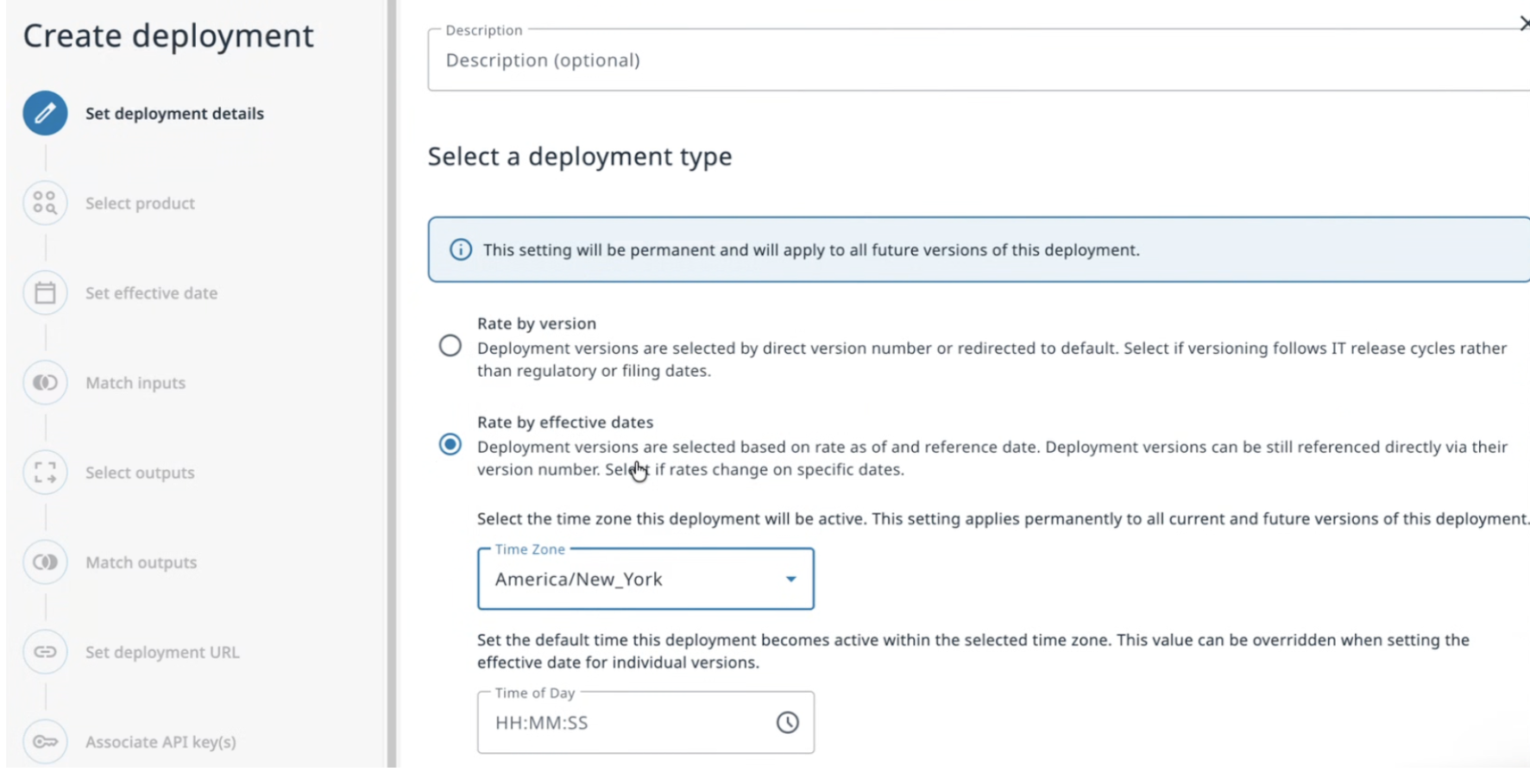
Instead of replacing a rate version at deployment, you add a new version with a defined effective date. Deploy automatically selects the right version for each transaction based on three date inputs:
- Policy Effective Date: the date the insured's policy starts, which determines the correct rate version at quote.
- Reference Date: the lookup date used to select insurance rates, typically matching the policy effective date.
- Rate As-Of Date: a freeze that locks a transaction to the rate version active at the time of quoting, so a newer version published between quote and bind does not re-rate the policy.
Here is how that plays out in practice: A broker quotes a Commercial Property policy in New York on February 2nd, with a March 15th effective date. Deploy routes the quote to the correct version for March 15th. When the broker binds the policy two weeks later, a newer rate version has been published, but the Rate As-Of Date keeps the bound policy on the original version. Three months into the policy term, a mid-term adjustment (MTA) triggers a recalculation using the newer rate book. The filed rate manual logic plays out automatically, with no manual intervention needed.
Scaling Across Lines of Business and States
Effective dates solve versioning for a single product. Product Selectors extend that logic across a full portfolio. Selectors — Line of Business, State, Coverage Tier — act as routing inputs that tell Deploy which deployment group to target before applying effective date logic.
One API key and one endpoint can support Workers’ Comp nationwide, plus Commercial Property and General Liability by state, routing every transaction to the right product and the right version automatically.
What It Means for Your Team
The benefits land differently depending on where you sit:
- Actuaries: plan future rate changes in advance, test against a specific effective date in UAT, and request promotion to production.
- IT teams:
- build the integration once, then apply future rate updates without replacing existing data or making further system changes.
- ensure the planned rate change will be deployed to production on the planned date without them having to manually coordinate it.
- Both teams: govern every rate change through a two-stage workflow (UAT to Production) with dual sign-off so that each change is reviewed, approved, and fully auditable.
One Platform, From Pricing to Production
The real value of Effective Date Routing goes beyond cleaner versioning. It gives actuaries and IT a single governed workflow, from the initial pricing decision to the live insurance rating transaction, so the handoff stops being a liability.