AI is changing what “market intelligence” means for P&C pricing teams. What used to be interesting context, locked inside messy filings, PDFs, and inconsistent terminology, has become robust and model-ready information that can be pulled, structured, and acted on in minutes.
In this article, we share five practical use cases from the Akur8 Academy webinar “Market Intelligence for Modeling & Ratemaking,” demonstrating how AI can turn market intelligence into actionable pricing inputs and filing-ready decisions.
AI can make filing-based market intelligence fast, structured, and actionable for ratemaking
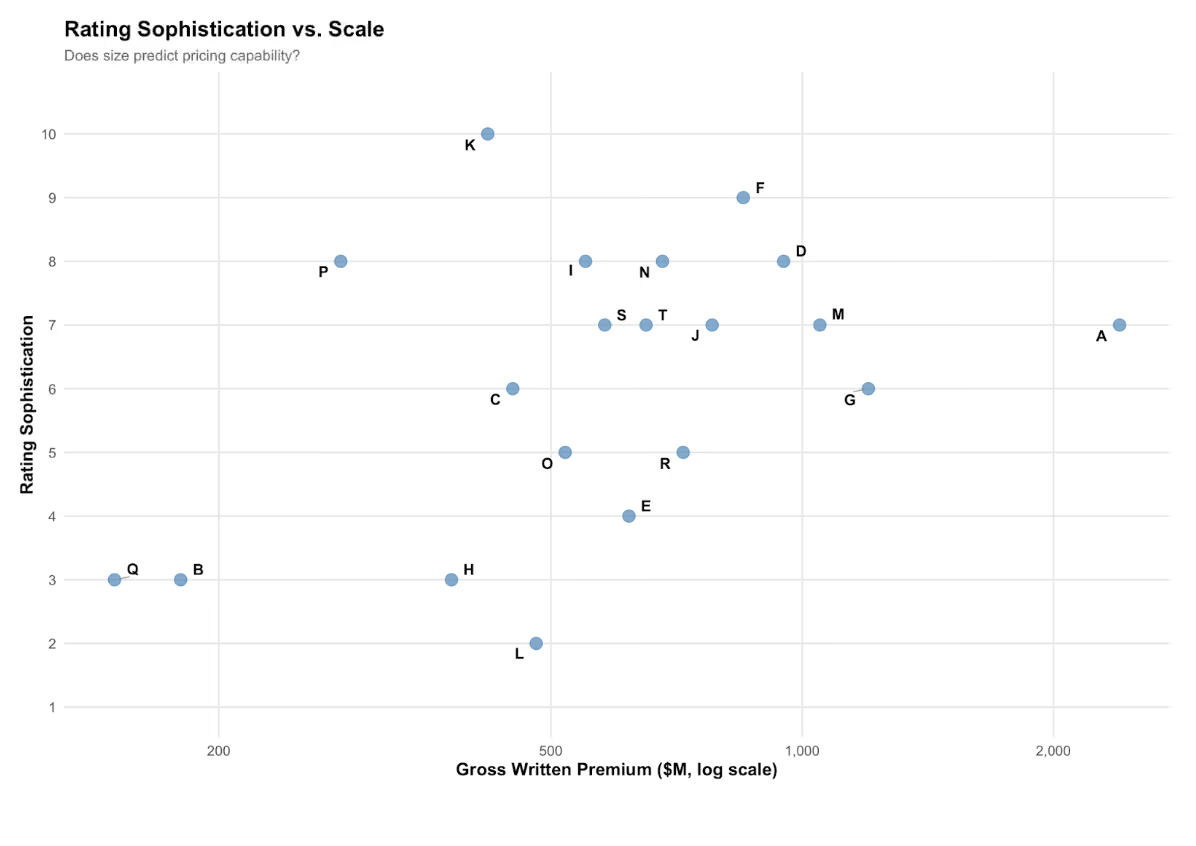
Generative AI is turning regulatory filings into a practical source of market intelligence that pricing teams can use, without months of manual research. Instead of reading dozens of documents carrier by carrier, AI tools such as Akur8 Discover can filter to the precise criteria you choose (line of business, state, time period, approval status) and extract comparable signals, like a structured view of rating variables and an approximate “rating sophistication” score.
Once that output is in a table, it’s easy to visualize and pressure-test hypotheses by layering in complementary business metrics such as gross written premium and expense ratio.
For example, the following scatter plot maps each carrier’s AI-derived rating sophistication score against its gross written premium (on a log scale) to quickly assess whether larger carriers tend to have more sophisticated rating programs.
The real value of AI is speed. Teams can run rapid test-and-refine cycles in minutes. As a result, they can uncover patterns that would be impractical to identify at scale, and translate market benchmarks into clear decisions about where added complexity is worth the investment.
While the model generates a sophistication score, actuarial expertise is what makes it decision-ready. Actuaries provide the context, validate assumptions, and ensure the output aligns with real-world pricing and regulatory considerations.
AI can make insurance filing analysis and factor curve benchmarking faster, clearer, and defensible
Generative AI can also help teams benchmark factor curves to guide selection.
In ratemaking, teams often have a current factor, an indicated factor, and the real-world need to select something defensible in between. Ideally, that selection comes with clear context on where it sits relative to recent market activity. Filings already contain this information, but extracting it has traditionally meant manually hunting through long PDFs and exhibits, and navigating inconsistent terminology (e.g., “package discount,” “multi-line discount,” or “companion discount”). The result? A slow process where key details slip through.
With AI, the same task becomes a structured, repeatable workflow:
Query recently approved filings for the right line of business, state, and time period
Extract the relevant factor values, curves, and business rules
Produce a side-by-side comparison, with traceable links back to the supporting documents
The result is faster, more complete market benchmarking. Pricing teams get a clear view of the discount level and how it’s applied (flat vs variable, multiplicative vs by peril, or varying by what’s bundled). This helps actuaries make more defensible selections with stronger justification and far less manual effort.
AI can reveal third-party data adoption and regulatory readiness from filings
Buying third-party (vended) risk scores can feel like a shortcut to sophistication, especially for perils where a carrier may never have enough internal data to build a credible model (for example, non-weather water risk).
But before adopting a third-party vendor score, teams need to answer a few practical questions that are often harder than the modeling itself:
Which vendors are already being used across the market?
Which carriers have successfully filed these scores?
Have regulators approved them for use as rating variables, and in which jurisdictions?
Generative AI speeds up that diligence by scanning filings to identify where a given vendor score appears, summarizing how it’s referenced and approved, and highlighting whether approvals are established or still in flux.
This insight helps teams avoid betting on a variable that could trigger a prolonged DOI review cycle, and instead choose third-party vended data that’s analytically promising and viable to implement and defend in a filing.AI can make filing monitoring proactive with automated alerts and material-change summaries
AI can make regulatory filing automation proactive with automated alerts and material change summaries
Staying ahead of filing and form changes is a constant challenge, not because the information isn’t available, but because monitoring it manually is cumbersome and rarely happens as often as teams would like. Market intelligence groups at large carriers may review filings on a cadence, but most organizations end up reacting after changes have already landed. Even industry newsletters can’t consistently cover the specific carriers and topics that matter to your book.
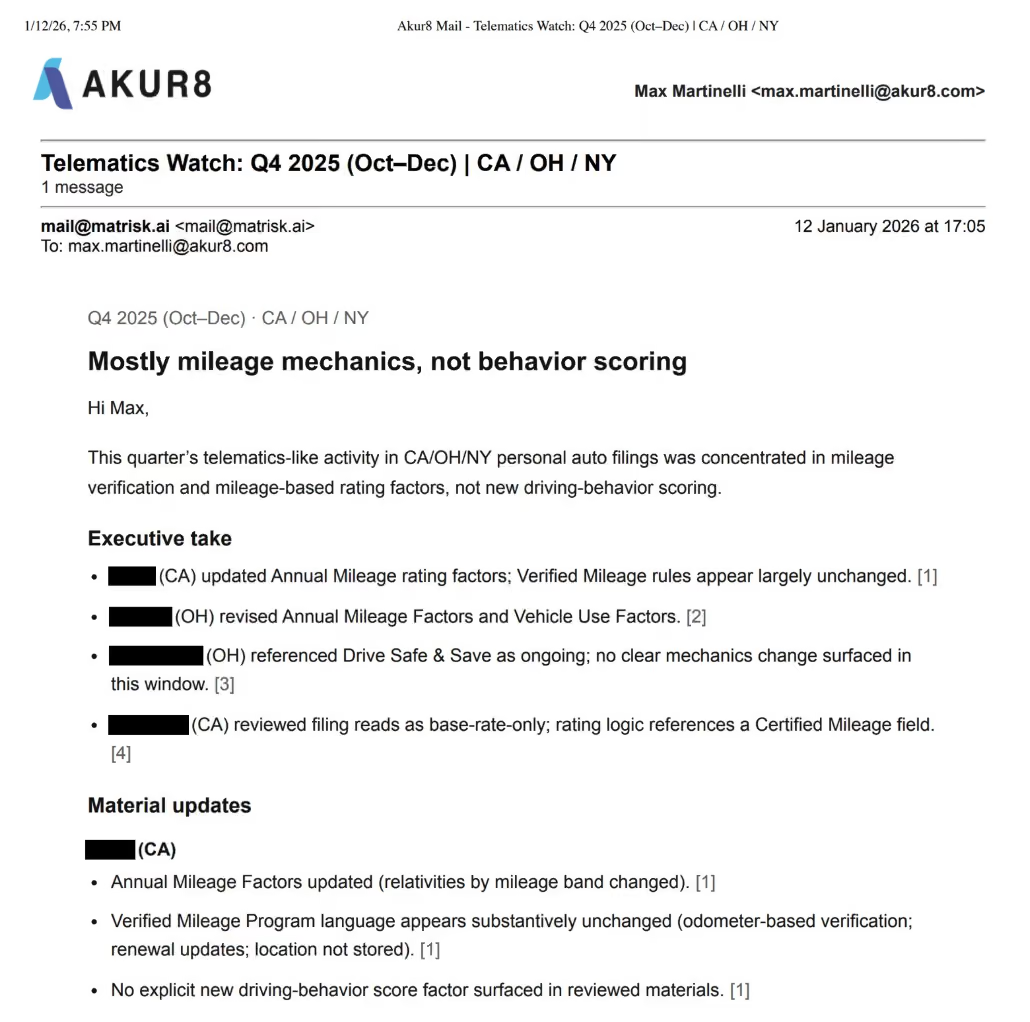
AI can enable a more proactive approach possible by delivering regular email summaries of material filing updates. Teams define what they want to track (carriers, states, and topics like telematics changes or emerging exclusions), and the system continuously monitors filings and sends the relevant updates instantly.
This is an example of an AI-generated filing email alert that summarizes material telematics changes in CA/OH/NY, highlighting what changed (and what didn’t) with source-backed references.
The result is market intelligence that behaves less like an occasional research project and more like an always-on alerting layer for product, pricing, and compliance teams.
AI can turn industry filings into offsets, priors, and practical pricing leverage
When entering a new state or launching a segment with limited credibility, actuaries often lack a defensible starting point. AI can now transform carrier filings into model-ready market intelligence, making “me too” benchmarks usable as more than just extra context. Those market factors can serve as a practical starting point, either as an offset (a baseline you model deviations from), a prior (a set of coefficients you shrink toward), or a complement (an additional benchmark signal alongside your own experience).
The breakthrough is that AI can rapidly parse and structure messy filings into consistent factor tables and rate components, enabling teams to operationalize market-based baselines quickly and keep them current. From there, familiar actuarial tools (credibility, offsets, and penalized regression) help you identify what’s truly different about your book without overfitting early noise.
Conclusion
AI is pushing market intelligence from a slow, manual research project into an operational capability that directly supports modeling and ratemaking. When filings can be parsed, structured, and monitored at scale, teams gain several advantages: faster benchmarking, factor selection with clearer context, third-party data evaluation with regulatory confidence, automated alerts for material market changes, and the ability to use market-based structures as disciplined starting points via offsets or priors.
The common thread across these use cases isn’t that AI replaces actuarial judgment. It amplifies it by delivering timely, model-ready signals and traceable evidence. As this becomes the new baseline, the advantage will go to teams that turn market intelligence into a repeatable workflow, one that strengthens the story behind indications and accelerates the path to filing-ready decisions.
Download our white paper: ""
Download our webinar replay: "Market Intelligence for Modeling & Ratemaking"
About the author
Andrew Whitney, Head of Applied AI Lab, Akur8
Drew Whitney leads Akur8’s Applied AI Lab, partnering with chief actuaries and product leaders to turn GenAI into production-grade workflows across filings, pricing, and market intelligence. As co-founder of Matrisk, he helped shape the emerging “filing AI” category, working with carriers and consulting firms to transform regulatory filings into a strategic data asset rather than a compliance chore. Drew comes from an enterprise IT and software background in complex, highly regulated environments, giving him a pragmatic perspective on how to deploy advanced AI in ways that are explainable, governed, and tied to measurable business outcomes.
Download our white paper: ""
Download our webinar replay: "Market Intelligence for Modeling & Ratemaking"



.webp)

